
Table of Contents
- Step 1: Define Your Vacation Home Goals and Budget
- Step 2: Vacation Home Mortgage Requirements You Must Meet
- Step 3: Second Home Tax Implications for Florida Buyers
- Step 4: Investment Property vs Second Home: Which Fits Your Plan?
- Step 5: Florida Insurance, Flood Zones, and Hurricane Risk
- Step 6: Closing Costs, Inspection, and Legal Review
- Step 7: Short-Term Rental Rules and Property Management
- Conclusion: Your Next Steps to Buying a Vacation Home
- Frequently Asked Questions
Last Updated: September 14, 2026
Step 1: Define Your Vacation Home Goals and Budget
Buying a vacation home starts with one uncomfortable question: will you use it enough to justify the carrying cost? Most buyers answer emotionally, then do the math. Flip the order.
Central Florida buyers often succeed when they write down three things before touring: how many weeks per year they’ll realistically occupy the home, the maximum monthly outlay they can absorb even with no rental income, and whether the property must break even or can run at a loss.
That last point decides everything downstream. A pure lifestyle purchase tolerates vacancy. An income-driven purchase does not.
- Occupancy goal: 4 weeks a year for personal use? 20?
- Carrying capacity: mortgage, taxes, insurance, HOA, utilities, lawn care
- Exit horizon: 3 years, 10 years, generational?
A common mistake is budgeting only the mortgage. In Florida, insurance and taxes can rival principal and interest on a modest property.
Buyers who skip the carrying-cost math often discover in year two that insurance alone pushed the payment beyond comfort. Run the full number before you fall in love with a listing.
Step 2: Vacation Home Mortgage Requirements You Must Meet
A second home mortgage is not the same product as a primary residence loan. Lenders price it higher, scrutinize it harder, and apply occupancy rules that can disqualify a property you love.
What Lenders Actually Look For
For a conventional second-home loan backed by Fannie Mae or Freddie Mac, the baseline expectations most lenders apply are:
- Credit score: Typically 680 or higher, with the best pricing reserved for scores above 740.
- Down payment: At least 10% down, though 15-20% is common for competitive rates. Primary-residence programs that allow 3-5% down do not apply here.
- Debt-to-income ratio (DTI): Usually capped around 43-45%, counting the new mortgage, taxes, insurance, HOA dues, and any existing obligations.
- Reserves: Lenders often want 2-6 months of mortgage payments in verified liquid reserves after closing. Investment-property loans can require 6-12 months.
- Occupancy: The home must be a second home for your personal use, occupied by you for some portion of the year, and not subject to a rental-management agreement that requires you to rent it out.
Because the home is not your primary residence, expect a rate premium over owner-occupied financing, often a quarter to half a percentage point.
Loan Products You Will Encounter
- Conventional second-home loan: The most common path. Best pricing, but strict occupancy and reserve rules.
- Jumbo second-home loan: For purchase prices above the conforming loan limit, which adjusts annually. Jumbo underwriting is stricter and reserves are higher.
- Investment-property loan: If you plan to rent the home frequently, the lender may reclassify it. Expect a higher rate, a larger down payment (often 15-25%), and more reserves.
- Asset-depletion or DSCR loans: Non-QM options that qualify you on assets or on the property’s rental income rather than your W-2. Useful for self-employed buyers and heavy-rental strategies, but rates are higher.
The Documentation Burden Is Real
Underwriting will ask for reserves, proof of primary residence, and a written explanation of how the second home will be used. If you plan to rent it out frequently, say so early, that answer can push the loan into investment-property territory, and discovering the reclassification after you’ve made an offer is expensive.
Get Pre-Approved Before You Shop
Talk to a lender before you tour a single property. A second-home pre-approval letter tells you what you can actually afford, not what an online calculator suggests, and signals to sellers that your offer is credible in a market where out-of-state buyers compete against cash.
Do not assume you can quietly rent the home on Airbnb and keep your second-home rate. Lenders audit occupancy, and misrepresenting intent on a loan application is mortgage fraud. If rental income is central to your plan, finance it as an investment property from day one.
Fannie Mae selling guide on second home and investment property occupancy
Step 3: Second Home Tax Implications for Florida Buyers
Second home tax implications hinge on one distinction: is the property personal or income-producing?
If you use the home personally and rent it 14 days or fewer per year, federal rules generally let you exclude that rental income. Cross into 15 days or more, and the property starts looking like a rental to the IRS, changing what you can deduct and how you report income.
Florida adds its own layer. There is no state income tax, a genuine advantage for many buyers. But the homestead exemption, which shields part of a primary residence’s assessed value, does not apply to a second home. You will pay the non-homestead rate.
Property taxes for non-resident buyers work the same way: assessed value times the local millage rate, with no homestead discount.
Tax residency is separate from vacation home status. Owning a Florida property does not make you a Florida resident for tax purposes, that depends on days present and intent. Consult a tax professional before assuming either way.
Step 4: Investment Property vs Second Home: Which Fits Your Plan?
The investment property vs second home decision changes your financing, your taxes, and your exit strategy. Pick deliberately.
| Factor | Second Home | Investment Property |
|---|---|---|
| Down payment | 10-20% typical | 15-25% typical |
| Interest rate | Lower premium | Higher premium |
| Rental use | Limited, personal use primary | Income-driven |
| Tax treatment | Personal-use rules apply | Depreciation, expense deductions |
| Financing scrutiny | Moderate | Stricter reserves required |
A second home is a lifestyle asset with tax advantages if personal use stays dominant. An investment property is a business asset judged on ROI, cap rate, and cash flow.
Many buyers blur the two and get the worst of both: investment-level costs with second-home-level income. Decide which you’re buying before you make an offer.
Step 5: Florida Insurance, Flood Zones, and Hurricane Risk
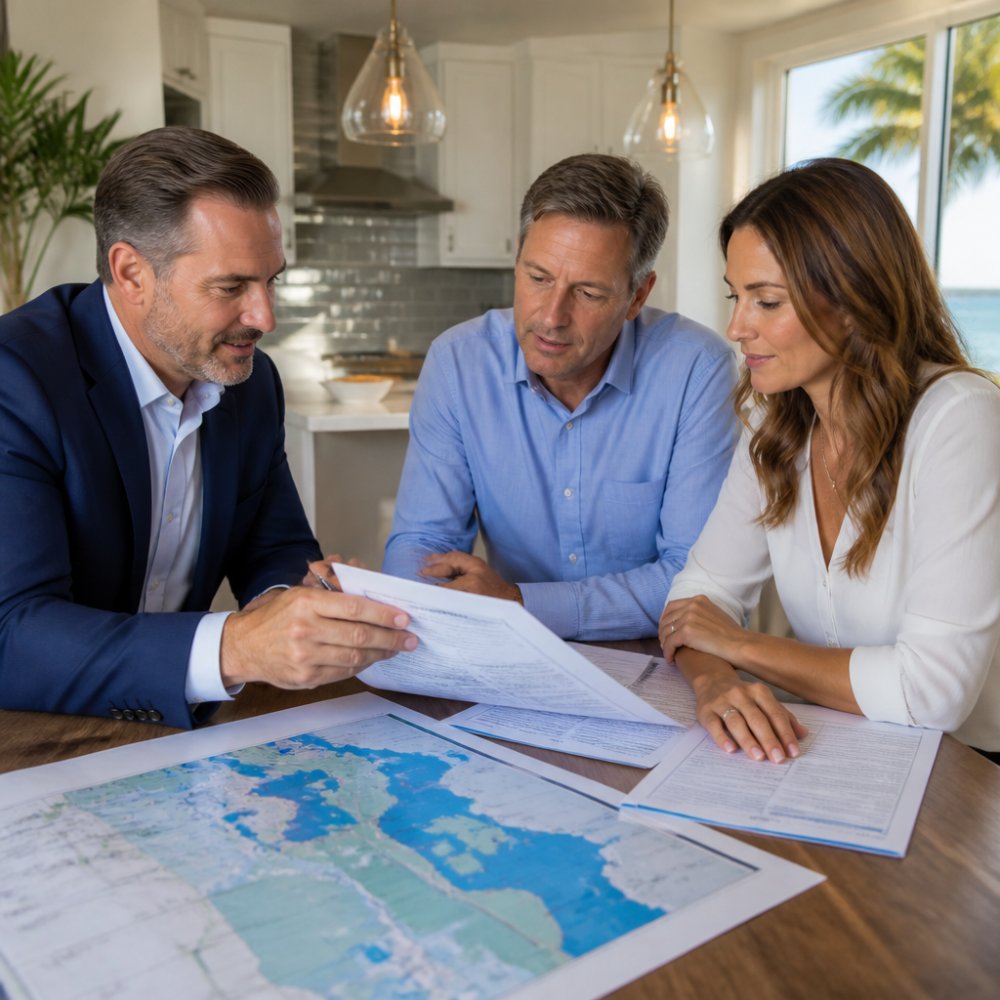
Insurance is where Florida transactions get complicated, and where out-of-state buyers get blindsided.
Property insurance in Florida differs materially from most states. Windstorm coverage is often a separate policy or deductible, priced accordingly. Flood insurance is almost always separate from a standard homeowners policy and is required for federally backed mortgages in designated high-risk flood zones.
Check the flood zone before you make an offer. FEMA maps classify properties by risk, and the zone drives both insurance requirements and cost. A property that looks dry can sit in a Special Flood Hazard Area.
Hurricane preparedness is part of ownership, not an afterthought. Impact windows, roof age, and construction type all affect insurability and premium. A home with an older roof may be difficult or expensive to insure.
Get insurance quotes during your inspection period, not after closing. A quote that comes back higher than expected can be a legitimate reason to renegotiate or walk.
Step 6: Closing Costs, Inspection, and Legal Review
Closing costs on a Florida purchase typically run a few percentage points of the price, and second homes carry the same costs as any financed purchase: title insurance, appraisal, escrow deposit, recording fees, and lender charges.
The closing disclosure, which lenders must provide before closing, itemizes every cost. Read it against your loan estimate and question any line that moved.
A home inspection is not optional here. Beyond structural and mechanical review, Florida inspections should address roof condition, HVAC age, moisture intrusion, and past water damage, findings that drive insurance and future maintenance costs.
Legal review matters because Florida uses attorney-supervised closings in many transactions and because contract contingencies, especially inspection and financing, are your protection. Understand your deposit’s refund conditions before you sign.
Step 7: Short-Term Rental Rules and Property Management
Short-term rental (STR) rules are the most underestimated risk in a Florida vacation-home purchase. Most national guides wave at the topic. This section gives you the actual verification process, because a rental ban discovered after closing is a permanent hit to your property’s income potential and resale value.
The Four Layers of Regulation
A Florida property can be governed by four overlapping sets of rules, and the strictest one wins:
- State law. Florida has repeatedly preempted, restored, and adjusted local STR regulation. State-level rules shift with each legislative session, so any guide older than a year is unreliable. Verify current preemption status before relying on it.
- County ordinances. Counties set their own licensing, inspection, and tax-collection rules, some require a vacation rental license and business tax receipt, annual safety inspections, or impose quiet hours, parking limits, and occupancy caps.
- City or municipal ordinances. Cities can be stricter than their county. Minimum-stay requirements (for example, a seven-day minimum), caps on the number of permitted rentals in a zone, and outright bans in residential districts are all common. A property one block over a city line can have completely different rules.
- HOA and condominium documents. This is where most deals die. Even where local law permits STRs, a homeowners association or condo board can prohibit them outright, cap the number of rentals, require a minimum lease term of 30 days or more, or charge rental registration fees. Condo documents often add their own restrictions on top of the HOA’s.
How to Verify the Rules for a Specific Address
Do not accept a listing agent’s verbal assurance. Run this checklist during your inspection period, in writing:
- Pull the property’s zoning designation from the county property appraiser’s website and confirm STRs are a permitted use.
- Search the city and county codes for short-term rental, vacation rental, and transient rental language. Look for minimum-stay rules, occupancy caps, and licensing requirements.
- Request the HOA and condo governing documents, declaration, bylaws, rules and regulations, and any recent board minutes on rental policy. Read the rental section yourself.
- Contact the local licensing office to confirm whether a permit is required, what the fee is, and whether the property is in a zone with a rental cap or waitlist.
- Confirm tax obligations. Florida imposes a state transient rentals tax on short-term stays, and most counties add a local option tourist development tax on top. Registration and remittance are the owner’s responsibility even when a platform collects on your behalf.
- Check for pending ordinance changes. Ask the planning department whether any STR rule changes are scheduled for a public hearing. Buying into a rule that is about to tighten is a common and avoidable mistake.
Ask for the HOA’s rental rules in writing before your inspection period ends. Verbal assurances from a listing agent are not binding, and a rental ban discovered after closing is an expensive surprise. If the seller will not produce the documents, treat that as a red flag.
Remote Property Management
For out-of-state owners, a local property manager is usually the practical answer. A manager handles guest turnover, cleaning, maintenance coordination, licensing compliance, and tax remittance, typically for a percentage of rental revenue plus fees for deep cleans and repairs. Management fees eat into ROI, but self-managing from another state is rarely workable when a hurricane, plumbing failure, or guest dispute lands on a Tuesday afternoon.
When you interview managers, ask specifically:
- How do you handle licensing and transient tax remittance?
- What is your fee structure, and what is excluded?
- How do you handle a storm or an emergency when I am out of state?
- Can you show me your current occupancy and average nightly rate for comparable properties?
Seasonality Shapes the Math
Central Florida rental income peaks around theme park and holiday travel and softens in slower months; coastal markets peak in winter and early spring. Underwrite your ROI against the slow season, not the best week of the year, a property that only pencils out at peak rates will disappoint you in September.
The STR rules that apply to a Florida vacation home are set by the strictest of four layers: state, county, city, and HOA/condo. Verify all four in writing before your inspection period ends, and confirm the transient tax obligations you will owe on every booking.
Florida Department of Revenue transient rentals tax guidance
Conclusion: Your Next Steps to Buying a Vacation Home
Buying a vacation home in Florida rewards preparation and punishes improvisation. Buyers who struggle usually treated it like a primary residence purchase with a nicer view.
David Dorman Realtor has guided Central Florida buyers through every one of these steps since 1999, from first budget conversation to closing table. David offers an exclusive interactive search portal, advanced marketing technology including Matterport 3D tours and drone galleries, and specialized expertise in probate and short sales, which can be beneficial for out-of-state and investor buyers.
If you’re ready to move from browsing listings to making a decision, request an appointment and get a local expert in your corner.
Frequently Asked Questions
Is it harder to get a mortgage for a vacation home?
Yes, it is generally harder. Lenders view vacation home mortgages as higher risk than primary residences, so they typically require higher credit scores, larger down payments of 10 to 20 percent or more, and lower debt-to-income ratios. You may also pay a slightly higher interest rate. Meeting with a lender early in the process helps you understand exactly what you qualify for before you start shopping.
What are the tax implications of owning a second home in Florida?
Second home tax implications include losing the homestead exemption, which is only available on your primary residence. You will owe property taxes at the non-homestead rate, and if you rent the home for more than 14 days per year, you must report that rental income to the IRS. You may deduct mortgage interest and property taxes on a second home, but rules differ from a primary residence. Consult a tax professional for your specific situation.
Is buying a second home in Florida a good investment?
It depends on your goals. Florida’s seasonal demand and strong rental market can generate income, but insurance costs, HOA fees, and property management expenses cut into returns. A vacation home that you also rent out can offset some costs, but you need to run the numbers on ROI carefully. Location, flood zone risk, and rental regulations all affect whether the property makes financial sense.
What is the difference between an investment property and a second home?
A second home is a property you use personally for part of the year and may rent out occasionally. An investment property is bought primarily to generate income or appreciation. The distinction matters for mortgage requirements, tax treatment, and insurance. Investment property loans often carry higher rates and stricter qualifying rules than second home loans, so knowing which category your purchase falls into before you apply is important.
What ongoing costs should I expect after buying a vacation home in Florida?
Beyond your mortgage, budget for property taxes, property insurance, flood insurance if required, HOA fees, utilities, lawn care, and property management if you rent the home. Hurricane preparedness costs, such as storm shutters or impact windows, may also apply. These ongoing costs can add up quickly, so factor them into your budget before you commit to buying a vacation home.